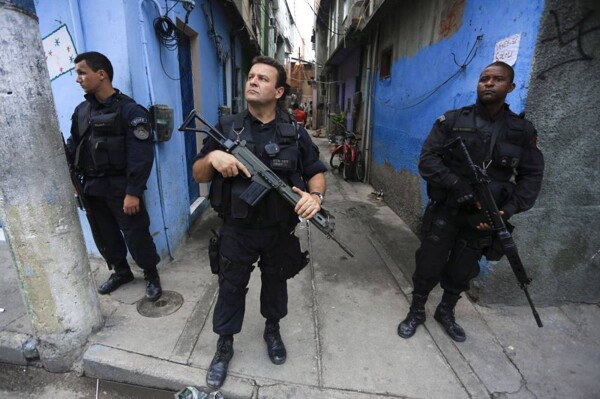
Flavio Bolsonaro, closely linked to the police in Rio de Janeiro and, as everything indicates, also with the state's paramilitary groups, the 'milicianos', is the head of the Public Security Commission of the Senate. Flavio was with his father in May when he arrived in Brasilia as an advisor to Secretary Rubio, and weeks earlier traveled to the United States where the clan lobbies at the White House and associates with far-right groups. From this position of power, he applauded this week's massacre that cost the lives of around 130 people (a number that could increase), after having advocated for a U.S. military intervention in Guanabara Bay. Messages. Having expressed his desire last week to have marines patrolling the sands of Copacabana, expressing admiration for the attacks on vessels in the Caribbean Sea, and supporting the militarization of the fight against common crime, was not the result of Flavio's verbal incontinence. On the contrary, it could have been a warning of what would happen a few days later in the Rio favelas. There were also dead from Complexo do Alemão, where other communities attacked by the Military Police are located. The fact that a declared Bolsonarist passed to treat his fellow party member, detained in Brasilia, with apparent disinterest. His first phone call upon arriving at the Palácio da Alvorada was to the Minister of the Civil House, Rui Costa, to deal with the crisis in Rio. The Bolsonaros are experts in coded messages and intimidations. Lula lands. On Tuesday night, when the first executions were supposedly taking place in Rio, President Lula landed in Brasilia after a week in Southeast Asia, where he met with his colleague Donald Trump. The Bolsonarist governor of Rio, Claudio Castro, declared that the bloodiest operation in history in the northern Rio communities was 'a success'. 'If they are terrorists, execute them!' The order to eliminate dozens of men, mostly young people, who had already been subdued, in the Rio de Janeiro favelas, seems to have been given from the highest levels of power. The bodies of these more than 60 fatal victims were found by neighbors early Wednesday morning in a forest area called Mata da Vacaria, a green labyrinth where alleged members of the Comando Vermelho drug cartel were trying to escape. One of those in charge of transporting the bodies to the urbanized area of the Complexo da Penha favelas was Raul Santiago. 'In 36 years in the favela, having gone through several massacres, I have never seen anything like what I am seeing today.' Next to the bodies, dozens of neighbors went from grief to indignation. Images of this collective wake held on Wednesday morning were picked up by local news channels, and then by global ones, which the day before had given extensive coverage to the Mega Operation Containment, carried out by 2500 police officers. The death toll on Tuesday was sixty-four, while the number of dead in a supposed, as yet unconfirmed, extrajudicial execution in the early hours of Wednesday rose to sixty-eight according to the Public Audit. For the Rio de Janeiro government, managed by Claudio Castro, the death toll from Tuesday to Wednesday reached one hundred and nineteen. Castro, a puppet serving the interests of former President Jair Bolsonaro and his family clan, declared that the bloodiest operation in history in the northern Rio communities was 'a success' and only regretted the death of 'four' victims: the police killed in shootouts with Comando Vermelho. 'This is something new.' Executed. According to residents who spoke without giving their names to the newspaper O Globo, some bodies had bullet holes in the back of the head, several had their hands tied. The expressions of the Bolsonarist governor were repudiated by human rights organizations and the PT's bench of deputies, who pointed to him as one of those responsible for the 'massacre.' Although it is not the first time a massacre has occurred in the communities subjected to a persistent state war against the predominantly poor, black population, the events of recent days have singularities. The Military Police's offensive on Wednesday, in the open, with armored vehicles and armed helicopters, left the highest number of deaths in Rio's history. The events of the early hours of Wednesday further increased the figures, making the ghastly Tuesday 28 and Wednesday 29, 2025 surpass the Carandiru Prison massacre, which occurred in 1992 in São Paulo and was the largest in history with 111 dead. The story of unarmed prisoners being machine-gunned in their cells by São Paulo agents was brought to the screen by Argentine director Hector Babenco in 2003. This event was a turning point: from the revulsion at that carnage arose the Primeiro Comando da Capital (PCC), the country's main drug cartel, which competes in firepower and money with the Comando Vermelho, born in Rio. Narco-terrorism. If Carandiru remained in history due to a series of firsts, the Operation Containment, against the favelas where hundreds of thousands of Brazilians live without debts to justice and a few members of Comando Vermelho, is also marked by singularities. One of them is that this case of extreme violence in the favelas coincides with the peak of the Bolsonarist discourse on combating narco-terrorism. Former President Jair Bolsonaro has militantly adhered to Donald Trump's recipe and as part of that adherence in May he expressed the need to classify Comando Vermelho and PCC as narco-terrorists during his meeting with Ricardo Pita, an envoy from Secretary of State Marco Rubio. In parallel, the former captain's party is pushing for reforms in Congress based on the assumption that the repression of these organizations requires the participation of the Armed Forces. A few months after meeting with Rubio's envoy, Bolsonaro was provisionally arrested for his usual destabilizing incitements, before being sentenced, as he was in September, to twenty-seven years in prison for his role as leader of the movement to oust President Luiz Inácio Lula da Silva. Deprived of making speeches and agitating through social networks, Bolsonaro entrusted those tasks to Flavio, a senator who knew how to build power in his father's shadow. Making a total of one hundred and thirty-two. Had he done so, it would have fed the strategy that fuels alignment with Trumpism in its hemispheric strategy. Signs that they were eliminated without offering resistance. Covered with blankets or improvised tarps, the bodies were placed side by side in San Lucas Square, in the Complexo da Penha favela. The issue returned to the center of concerns on Wednesday during the emergency cabinet meeting where the first measures were adopted. One of the decisions was to instruct the Ministry of Human Rights to support the families of those murdered in the favelas, while other federal agencies monitor the progress of the investigations, including what happened in the early hours of Wednesday. But perhaps the most important decision was to refuse to sign the deployment of the Armed Forces to the Rio favelas, as proposed by Flavio Bolsonaro and suggested by his henchman, Governor Claudio Castro. Brutal.

Rio de Janeiro Massacre: Political Crisis and Accusations Against Bolsonaro
Rio de Janeiro witnessed one of the bloodiest operations in its history, resulting in over 130 deaths. Senator Flavio Bolsonaro and state governor Claudio Castro endorsed the forceful actions, drawing sharp criticism from human rights organizations and President Lula. The investigation is ongoing.